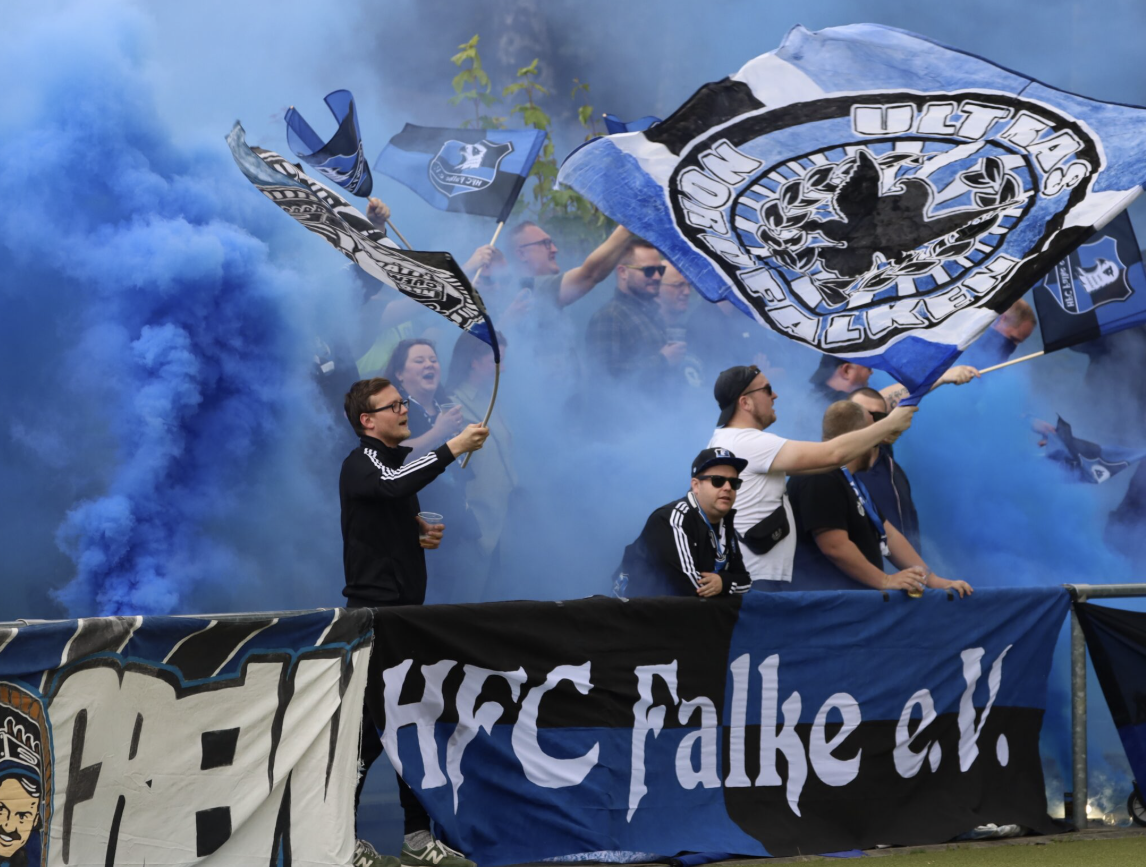
AFC Wimbledon, Altona 93, FC United of Manchester and HFC Falke are among the most celebrated forces for good in modern football — supporter-owned phoenix clubs that have captured the hearts of fans well beyond their own communities. But how robustly do they protect what matters most? Can their leadership change the club name, logo or colours without member consent? Can the club move away from its historic ground without scrutiny? And is it possible to dissolve or merge the club against the wishes of its members? As one would expect from clubs founded on principle, most of their crown jewels are well protected — with one significant and surprising exception.
Extreme Protection at HFC Falke
HFC Falke are a Hamburg football club founded in 2014 by Hamburger SV supporters. The name honours two of the three clubs whose merger created Hamburger SV in 1919: Hamburger FC (founded 1888) and FC Falke (founded 1906). Their statutes set a standard for identity protection that no other club examined comes close to matching.
The official club name, the colours black, white and blue, and the crest — described in the statutes as depicting a falcon in the club colours — can only be changed with the consent of every single member. Since membership is open to any natural person, this unanimity requirement makes a change to any of these elements practically impossible. Paradoxically, it is easier to dissolve or merge the club than to rename it: dissolution and fusion require a three-quarters majority of voting members present at a general assembly, a lower bar than unanimity. The club's founding document describes HFC Falke in their preamble as "unveräußerlich" — inalienable — and its statutes make that claim structurally real.
Solid Protection at AFC Wimbledon and Altona 93
The most famous phoenix club in world football also has robust protections, though delivered through a different mechanism. Most governance decisions pass through The Dons Trust, which owns 50.01% of AFCW plc and exercises those shares as a single block vote — meaning investors cannot shift the balance of power by influencing individual Trust members.
The Dons Trust constitution protects the club name AFC Wimbledon and the nickname "The Dons", requiring a two-thirds majority of members present in person or by proxy at a general meeting — with the additional safeguard that at least 50% of all members eligible to vote must be in attendance. The same two-thirds threshold and quorum requirement applies to any sale of the freehold or permanent relocation from Plough Lane, the club's home stadium. The primary colours yellow and blue, and the badge and crest, require the same two-thirds member vote at a general meeting, though without the fixed attendance quorum. Dissolution of AFC Wimbledon can only be effected by three-quarters of all members actively signing a formal instrument of dissolution.
Altona 93, the Regionalliga cult club from the same city as HFC Falke, employs a similar approach. The club name — formally "Altonaer Fussball-Club von 1893 (Altona 93)" — the colours black, white and red, and the club crest are all written into the statutes, protected by the general amendment clause requiring a two-thirds majority of voting members present at a general assembly. Dissolution and fusion of the club are subject to a higher threshold: a three-quarters majority at a specially convened meeting. One notable gap is the Adolf Jäger Kampfbahn: the historic Hamburg ground is not named anywhere in the Altona 93 statutes, and a relocation appears to be possible under current constitutional arrangements without requiring member consent.
Limited Protections at FC United of Manchester
At FC United of Manchester — founded in 2005 following supporter protests against the Glazer leveraged takeover of Manchester United — protections on dissolution and fusion are robust: both require an extraordinary resolution of 75% of votes cast.
What is surprisingly absent, however, is any constitutional protection for the club's visual identity. The club name is protected indirectly — as Rule 1 of the statutes, any change requires the same 75% extraordinary resolution — but the club logo does not appear anywhere in the rules, despite a reproduction of it featuring on the document itself. There is no clause requiring member consent to change the badge. The club's home ground, Broadhurst Park, is similarly absent from the rules, with no protection against relocation. On colours and playing kits, the rules require only that any proposed change be placed before the Annual General Meeting — where an ordinary resolution, meaning a simple majority, is sufficient to approve it. For a club whose entire founding purpose was the protection from commercial capture, the absence of constitutional protection for logo, ground and colours looks inconsistent.