The Maltese men's football pyramid consists of four layers. The top layer, the Malta Premier League, operates with 12 teams in an expanded South American-style Apertura and Clausura format. Below it sits the Challenge League with 16 teams, followed by Amateur League I with 14 teams and Amateur League II with 12 teams at the base. Between all divisions there are proper promotion and relegation paths, with at least two teams moving up or down at every level.
Pyramid Access
Under article 9.4 of the Statute of the Malta FA, only one club from the same locality may be a member of the Malta FA. A locality qualifies as such if it is legally entitled to its own local council.1 This means clubs cannot freely enter the pyramid system. On the main island of Malta, the localities of L-Iklin and Ħal Safi are currently the only ones without a club. Pembroke is an exception: it is home to both Pembroke Athleta FC and St Andrews FC, protected by a clause that prevents clubs from losing their Malta FA membership should a locality's entitlement to its own local council change.
Gozo
The island of Gozo operates its own football federation, the Gozo FA, with a Premier level (L-Ewwel Diviżjoni) and a Second level (It-Tieni Diviżjoni), with promotion and relegation between them. These competitions have no direct relationship to the main Maltese pyramid. Clubs cannot earn promotion to the main pyramid by winning the Gozo championship — they can only apply for Malta FA membership and hope their request is approved.
In the past the Gozo FA ran a representative side, Gozo FC, which was accepted into the main pyramid and played one season at the top level, in 1999–2000. Victoria Hotspurs later became the first club from the Gozo Premier League to transfer to the main pyramid in their own right. Their 2024 Malta FA membership application was successful; they entered at the fourth level and immediately earned promotion to the third.
This raises the question of why the Gozo league was never made a direct feeder into the Maltese fourth level, or positioned alongside it with a promotion path to the third. The Gozo league has in any case been treated with considerable care by the Malta FA: earlier clubs that sought Malta FA membership — Nadur Youngsters, Xewkija Tigers, Kerċem Ajax and Għajnsielem — were all rejected, as the Malta FA did not wish to undermine the Gozo league. Notably, the one-club-per-locality rule that applies on the main island does not appear to apply within the Gozo FA itself: Victoria Hotspurs, Victoria Wanderers and Oratory Youths all hail from the Victoria council area.
No Proper Home Grounds
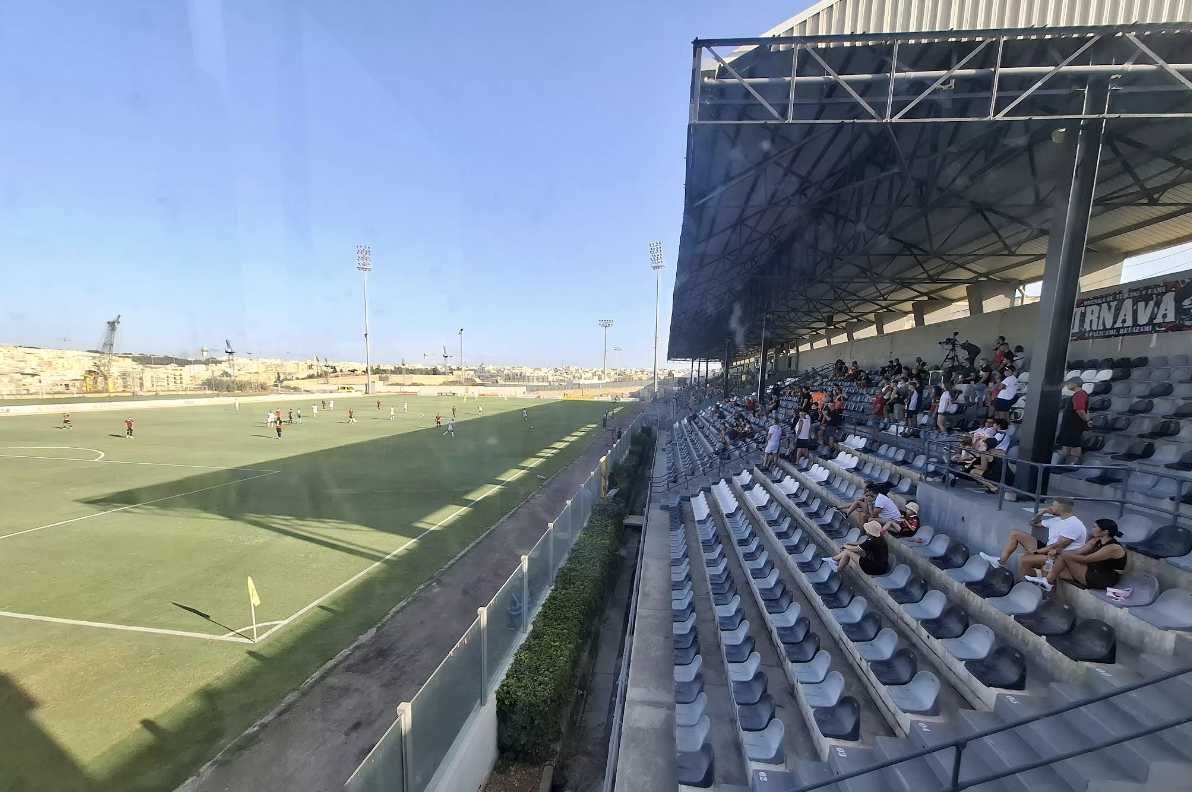
Only five grounds are used in the Maltese Premier League: three independent venues and two club-owned stadiums. The independent grounds are the large national stadium Ta' Qali (capacity 16,997) and the smaller Centenary Stadium, both situated near the ancient citadel of Mdina, and the Gozo Stadium in Xewkija — despite no Gozitan club currently competing at the top level. The two club-owned grounds are the Tony Bezzina Stadium of Hibernians FC and the Victor Tedesco Stadium of Ħamrun Spartans FC, both of which have hosted UEFA competition matches.
In the current season, the majority of fixtures have been played at Ta' Qali and the Tony Bezzina Stadium, each hosting between 50 and 75 matches. The Centenary Stadium and the Victor Tedesco Stadium have each taken between 25 and 30 games, while the Gozo Stadium has hosted just six. The contrast between the two club grounds is big: Hibernians have played 17 matches at their own stadium — more than half of their fixtures — while Ħamrun Spartans have used theirs for just four. In lower divisions, the Luxol Stadium in Pembroke, the Sirens Stadium in St Paul's Bay and the Charles Abela Stadium in Mosta are also used.
New Stadiums
Several major infrastructure announcements have been made in recent months. On 15 April 2026, the regeneration of the Ta' Qali National Stadium was confirmed, comprising partial reconstruction and modernisation of the main ground — reducing its capacity to 12,000 seats but upgrading it to UEFA Category 4 standard — alongside an expansion of the Centenary Stadium to approximately 2,500 seats and the construction of a new 2,000-seat youth football stadium on the same site.
Historic club Floriana announced on 22 August 2024 a 4,000-seat stadium at the Independence Arena, close to the historic City Gate of Valletta in the heart of Floriana. Parliament approved a 45-year lease of the ground on 19 May 2025. The venue carries particular historical significance: it was here that the Maltese flag was hoisted for the first time during independence celebrations on 21 September 1964. Valletta FC has also announced a Football Campus project in Pembroke, though the site lies some distance from the city of Valletta itself.
Perhaps the most revealing development is the announcement on 30 March 2026 of a new UEFA Category 3 stadium in Marsa, to be owned not by any individual club but by the Malta Premier League itself, built on land behind the Matthew Micallef St John Athletics Stadium. With an artificial pitch to maximise usage and a planned capacity of 5,000, the project reflects a broader tension in Maltese football infrastructure: while more stadiums are being announced than at any time in recent history, the construction of a centrally owned multi-club venue by the league itself suggests that scarce availability of land continues to favour a shared, centralised approach over encouraging clubs to develop their own grounds.
From Supporter Ownership to Foreign Investment
Almost all Maltese clubs remain supporter-owned — for now. But the Legal Notice 912 from the Maltese government published on 10 April 2026 and coming into force in June 2026, will change the landscape considerably. Under the new framework, companies may establish Sports Private Limited Liability Companies (SPLLCs) to assume responsibility for the management, operation and administration of a football club. However, at least 10% of shares must be reserved for a non-profit foundation or association. Through this mechanism, clubs retain the ability to block changes to their intellectual property — logos, names and colours — as well as withdrawal from the Malta FA, since votes on those matters require unanimity under the new regulations.
The first sign of change has already arrived. Newly promoted Malta Premier League club Birżebbuġa St Peter's has been taken over by 77 Sports, a United Kingdom-based entity describing itself as a global sports platform, which will acquire an 80% stake in the club. Meanwhile, Maltese football has had its first brush with multi-club ownership as well: Ħamrun Spartans president Joseph Portelli pursued a takeover of Italian Serie D side Nocerina Calcio from the Campania region, though his bid ultimately fell through following due diligence.